Plantations and cockatoos
AFPA sets out workable plans for growers to help endangered birds.
AFPA has made two submissions on draft national recovery plans for the gang-gang cockatoo and south-eastern red-tailed black cockatoo.
Central to both submissions are misunderstandings by the Department of Climate Change, Energy, the Environment and Water where the role of plantation forestry within conservation practices is poorly interpreted in the proposed recovery plans.
In its response to the gang-gang cockatoo draft national recovery plans, AFPA suggests “that the draft National Recovery Plan repeatedly conflates forestry with land clearing, agriculture and urban expansion.”
The response notes that while gang-gangs use plantation forests as temporary sources of shelter and food, those forests do not “without evidence of a material ecological function, demonstrate that the commercial crop constitutes breeding habitat, significant foraging habitat, a functional movement corridor or habitat critical to survival”.
The focus on retaining native vegetation within plantation sites is done consciously for habitat reasons and “Their presence must not result in the surrounding commercial plantation crops [also] being classified as habitat.”
As the submission says: “While there are a range a forestry practices, the essence of a forestry operation is sustainability where harvested trees are at a minimum fully regrown. In this context, we note that the earlier TSSC Conservation Advice on the status of the gang-gang makes a clear distinction between land clearing and native forest timber harvesting. This distinction should be included throughout the National Recovery Plan – thus avoiding any unintended ambiguity.”
AFPA’s submission on the draft National Recovery Plan for the south-eastern red-tailed black cockatoo notes that the industry has taken considerable voluntary measures to enhance the long-term viability of this species.
Companies have worked in partnership with Birdlife Australia and Zoos SA on projects including:
- Establishing and monitoring artificial hollows for nesting, with fledglings reported.
- Establishing new areas of brown stringybark and buloke in areas adjacent to our plantations.
- Undertaking annual surveys of birdlife throughout the region.
- Volunteering to participate in the annual red-tailed black cockatoo count.
While noting that the affected plantation companies supported conservation measures such as protecting nesting habitat from illegal firewood collection and removing woody weeds and wilding pines within priority habitat areas, AFPA acknowledges they have practical limitations on these activities, ranging from out-of-hours attacks to difficulty gaining legal access to neighbouring properties.
The submission calls for government support and an inter-agency approach that will help to easily resolve the issues without putting a significant burden onto growers.
A statement from AFPA said: “We support the conservation and recovery of the Gang-gang Cockatoo and appropriate protection of confirmed breeding habitat, significant foraging areas, refuge areas and important native vegetation.
“For the south-eastern red-tailed black cockatoo, AFPA broadly supports the proposed actions while emphasising that harvesting and silvicultural activities should not be unnecessarily restricted in areas adjacent to identified habitat.”
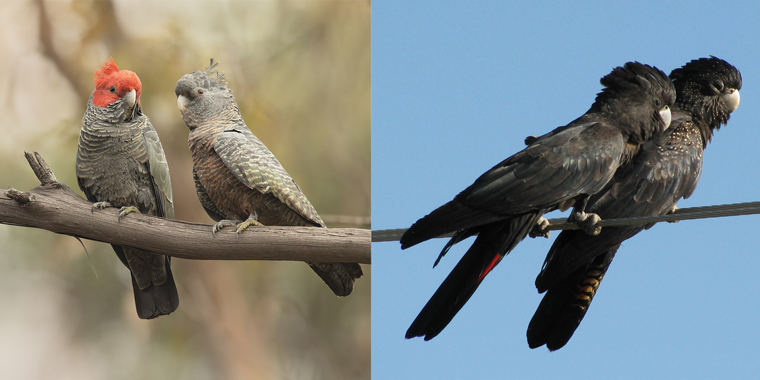
MAIN PIC: (Left) Endangered gang-gang cockatoos; the male has a red head. Image: CC Wikimedia/JJ Harrison; (Right) A pair of Red-tailed Black Cockatoos: male on left and female on right. Image: CC Wikimedia